Rolex made the Submariner ref. 5513 from 1962 to around 1989. That makes it one of the brand’s longest running models, which collectors sometimes call the “purist’s Submariner.” It’s mostly distinguished by a two-liner dial without a date and a vintage acrylic crystal, setting it apart from contemporary sapphire-clad models.
Key Takeaways:
- Production Run: 1962 to 1989, spanning nearly three decades of watchmaking evolution
- Key Feature: Two-line dial (non-chronometer) compared to the four-line chronometer-certified 5512
- Variations: Gilt dials, matte dials (meters first and feet first), and glossy dials with the rare “spider” effect
- Value: Widely considered the best entry point for vintage Rolex collecting
The 5513 may look simple, but it’s a minefield of complications, bracelet iterations, dial variations, and model year changes. In this guide, I break down every variation of this timepiece. From early gilt dials to late glossy models, know what to expect in the vintage market, and know what to buy.
History of the Rolex Submariner 5513

The 5513 was the successor to reference 5508 and was introduced in the early 1960s along with its more expensive cousin the 5512. While the 5512 was a COSC-certified chronometer, the 5513 was not. This made the 5513 accessible to the working man, the real diver, the military and adventurer who needed a tool watch but without the chronometer price tag.
Over the course of its 27 year production run, the 5513 experienced all three distinct eras of Rolex watch manufacture. Early 1960s models included radium luminous material, gilt dials and gold colored text. During the late 1960s and the 1970s, the watch began to feature matte dials with tritium lume. In the mid 1980s, Rolex transitioned the 5513 once again by introducing glossy dials and white gold surrounds on the hour markers. This gave the 5513 a modern look before its discontinuation in 1989.
Rolex 5513 vs. 5512: What’s the Difference?

| Feature | Rolex 5513 | Rolex 5512 |
| Production Years | 1962-1989 | 1959-1978 |
| Movement | Cal. 1520/1530 (non-chronometer) | Cal. 1560/1570 (COSC certified) |
| Dial Text | 2 lines (cleaner appearance) | 4 lines (includes chronometer designation) |
| Certification | Non-chronometer | COSC Superlative Chronometer |
| Rarity/Price | More available, wider price range | Rarer, typically commands higher premium |
The Three Main Eras of 5513 Dials
Variations in watch dials can affect the overall value of the watch because they provide important authentication markers which in turn affect market value. The 5513 model experienced three primary dial eras, each marked by unique features and representing distinct phases in Rolex’s production history and aesthetic preferences.
The Gilt Dial Era (Early 1960s to ~1966)
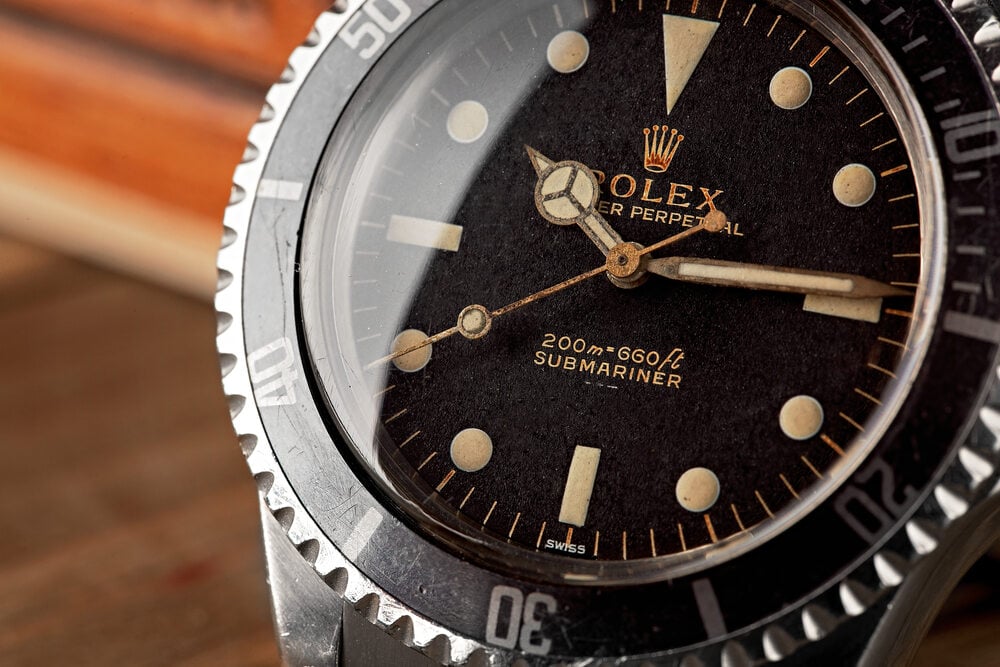
Gilt dials have gold-colored text, which is simply just the underlying brass dial plate showing through the glossy black finish. They are particularly warm-toned, with a honey-color, under certain lighting conditions on these earliest examples. The name “gilt” is in reference to the printing technique, not the use of actual gold. They were used in combination with radium luminous material and then later Tritium, which has, over time, usually turned a deep cream or beige color on surviving watches.
Around 1966, models with a “Bart Simpson” dial started popping up, named for the flat, squared-off coronet design that resembles the cartoon character’s hair. These dials also featured variations in the chapter ring, with early examples showing an “open” chapter ring, which doesn’t feature the ring around the outside of the minute markers, while later examples moved to a “closed” chapter ring design. Gilt dial 5513 watches are still highly sought after, representing the earliest and purest expression of the reference.
The Matte Dial Era (1966 to ~1984)

Matte dials replaced the highly reflective gilt-style dials and adopted a more subdued matte black dial with printed white text. One of the major variations of this era is that early matte dials have “200m = 660ft” while the late matte dials, circa 1969/1970, have the text reversed to “660ft = 200m”, with the imperial text first. Note that not all late matte dials are the same.
The late 1970s and early 1980s brought about what collectors call “Maxi” dials, featuring much larger luminous plots on the hour markers. These evolved through five recognized types (Type I through Type V), with each showing different types of typography and text placement. The maxis were an attempt by Rolex to make the watch more legible in low-light conditions. Many collectors prefer the earlier, more delicate, matte dial.
The Glossy Dial / White Gold Surround Era (1984 to 1989)
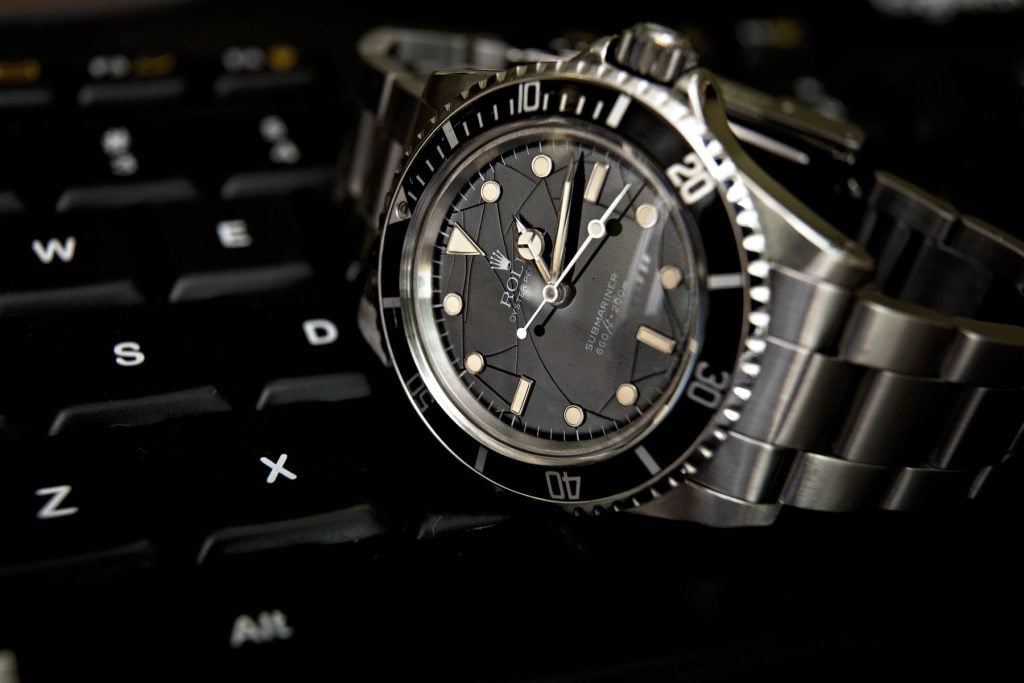
In its final years of production, the 5513 adopted glossy black dials with applied hour markers surrounded by white gold. This new direction more closely resembled modern Submariner models, but it maintained the two-line text and acrylic crystal unique to this reference. The glossy surface finish gives it a very reflective surface as compared to the flat dials of the earlier, matte production watches.
Seen only in this production era is the “spider dial” where the lacquer finish develops a crackled, spider-web like effect. A spider dial is the result of varying temperatures and the effects of age on the lacquer used to produce the glossy surface. The problem is usually caused by the lacquer layer lifting and contracting slightly as the two materials have different coefficients of expansion. The result is the formation of a myriad of hairline cracks on the surface of the dial. Opinions are mixed in the collector community as to whether spider dials are desirable patina or damage.
Rare & Holy Grail Variations

Outside the standard production models, some 5513 variations command massive premiums on the secondary market, driven by collector interest due to their rarity and historical significance.
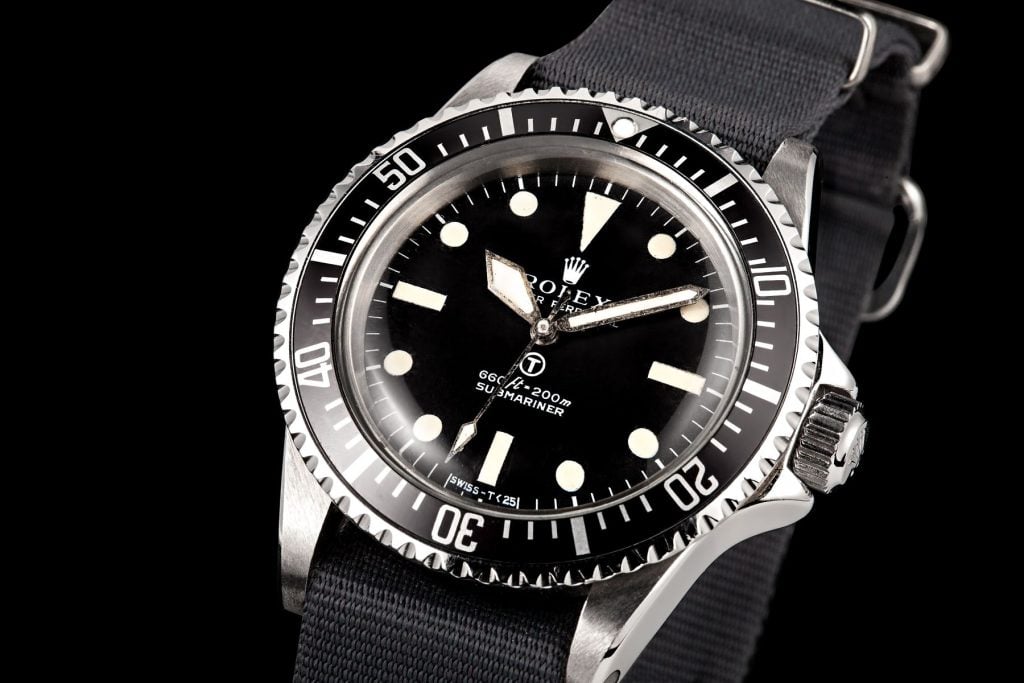
The MilSub (Military Submariner): The British Ministry of Defence ordered modified 5513 watches for the Royal Navy. These came with fixed spring bars for attachment of a NATO strap, had sword hands for better legibility and a “T” on the dial indicating the use of tritium luminous material. Sometimes these MilSub references are given a reference number of 5517 if they are heavily modified. MilSub are some of the most coveted and collectible 5513s and tend to reach six figures when sold at auction.
The Explorer Dial: An ultra-rare dial with 3, 6 and 9 o’clock positions marked with Arabic numerals instead of the regular hour markers. It is unknown how many were made, but they are so rarely seen they make the rounds of collector forums when they do show up.
Comex: The famous French diving company Compagnie Maritime d’Expertises (Comex) also ordered 5513 watches, sometimes with helium escape valves, often with other modifications. These commercial diving watches can be seen as the overlapping line between Submariner and Sea-Dweller, the ultimate in professional usage for which Rolex built their reputation.
Movements & Bracelets: The Engine and Chassis

The mechanical and structural components of the 5513 evolved throughout production, with changes reflecting Rolex’s continuous improvement philosophy and response to real-world use.
Caliber 1520 vs. 1530
The early 5513s were equipped with the Caliber 1530 movement but the majority were the Caliber 1520. Although they were not COSC certified chronometers like the movements in the 5512, the movements in the 5513 were more than up to the task in real-world conditions. The use of non-certified movements kept the cost down and it became the diver’s choice for working conditions. Automatic winding and hacking seconds were found on both calibers as these were necessary for professional dive timing.
Bracelet Evolution
The 5513 has gone through three major bracelet types that can be used to date examples. The rivet bracelet (ref 7206) that came on early watches has visible rivets between links and is hollow, giving it a somewhat lighter feel than current bracelets. The folded link bracelet (ref 9315) was a transitional style, also hollow but more refined than the rivet design, which was sometimes considered delicate. Solid link bracelets (ref 93150) arrived in the 1980s, adding weight and durability. Solid links are considered by many to be the ideal choice for daily wear. Each style has its fans, with rivet bracelets considered the most correct for early examples, while solid links suit those that favor wearability.
The James Bond Connection
The James Bond connection adds another element to the story of the 5513. Sean Connery wore a Rolex Submariner reference 6538 in the earlier Bond films, but Roger Moore wore the 5513 starting with Live and Let Die in 1973. The film features the watch with an altered rotating bezel used as a buzz saw, and as a magnetic field generator. Moore’s wristwatch is a standard issue military Submariner made special by Q Branch.
This exposure helped the 5513’s status rise above that of a practical tool watch for professional divers. The connection to Moore’s portrayal and the broader “King of Cool” aesthetic associated with vintage sports watches helped cement the 5513’s status as a cultural icon. Steve McQueen, another figure frequently linked to vintage Rolex Submariners, contributed to this mystique, though his watches included various Submariner references that together built the model’s rebellious, masculine image.
Buying Guide: Condition & Authenticity

Navigating the vintage 5513 market requires careful attention to originality and condition, as modifications and replacements can significantly impact value and authenticity.
Case Polish: Over-polishing is a typical condition issue. Rolex cases are beveled and chamfered on the lugs, areas that can be easily lost with heavy polishing. Signs to look for are thin lugs and crisp edges where polished metal meets brushed metal. Original unpolished cases will usually carry a premium while heavily polished examples will be devalued.
Dial Originality: Service dials replaced during Rolex servicing pose authentication challenges. Replacement dials from later service periods may feature luminova that glows bright white under UV light, contrasting with original tritium that no longer glows but has aged to match the hands. Ensure the luminous material on both hands and dial markers shows consistent patina color, ranging from cream to deep orange depending on age and storage conditions.
Bezel Inserts: Aluminum bezel inserts that have faded to a light silvery color or completely “ghosted” over to grey or blue are popular with some collectors as a sign of authenticity, as well as the “kissing 40” versions where the 4 and 0 touch when they are printed just so. Replacement inserts that are not original to the watch are abundant in the aftermarket, so the insert is often an important detail in authentication.
Matching Patina: Cohesive aging across all luminous elements indicates originality. When dial markers show pumpkin orange patina but hands remain cream-colored, this mismatch suggests replaced components. Authentic aging happens uniformly across parts exposed to the same environmental conditions over decades.
Price & Investment Potential

Pricing for the 5513 runs the gamut from the lower end, widely-available late-production glossy dial watches that can be had for $10,000 or so to six-figure prices for desirable military-issued MilSubs. Generally, a matte dial 1970s-early 1980s production example will sell in the $9,000-$15,000 range with a nice 1960s gilt dial example will command a $25,000 to $40,000 or higher price tag based on condition and details.
Performance as an investment has been strong across the vintage Rolex spectrum, with the 5513 broadly categorized as a “blue chip” piece. This is due in large part to the fact that Rolex no longer makes acrylic crystal Submariners, and as such, the 5513 remains the last embodiment of the watch’s original personality. In addition, the continued influx of younger collectors who wish to buy vintage versions of contemporary sport watches is another tailwind that has kept demand and appreciation strong. Rolex, the 5513’s relative affordability versus earlier references and the historical importance of the reference combine to make it a sound long-term collector’s investment with significant upside potential.
Why the 5513 Remains the King of Vintage Dive Watches

The Rolex Submariner 5513 achieves a rare balance between vintage character and practical wearability. The acrylic crystal provides warmth and a dimensional quality that sapphire cannot replicate, while the steel construction and 200-meter water resistance mean the watch can handle daily wear without excessive concern. The no-date configuration creates dial symmetry that many enthusiasts prefer over date complications, making the 5513 a potential one-watch collection for those seeking simplicity and elegance.
Whether pursuing a pristine collector-grade example or a naturally aged tool watch for daily use, sourcing from reputable dealers protects against the frankenwatches and heavily modified pieces that populate the market. Birth year watches hold particular appeal, allowing owners to wear a piece manufactured during personally significant years. For collectors ready to begin their vintage journey or add a specific 5513 variant to their collection, exploring curated selections of used Rolex watches from established dealers like Bob’s Watches ensures access to authenticated, properly represented examples.