
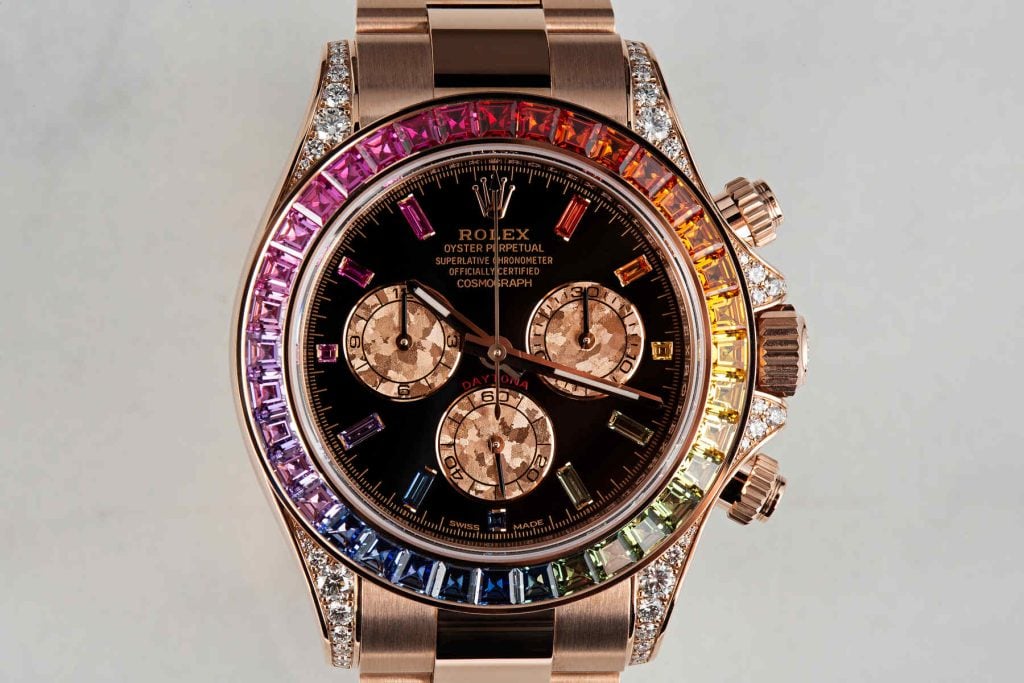
The Rolex Daytona Rainbow is one of the most exclusive variants made by the Crown that differs from other Daytona watches with a dazzling rainbow bezel set with 36 baguette cut sapphires. The gems, set in a gradient, work together to display all of the colors of the rainbow. The official first sale of the modern Rainbow Daytona was in 2012, however one of the first prototypes from the 1990s recently sold at auction for $6.3 million. Today, the Rainbow Daytona is a true status symbol and showcases Rolex’s masterful gem setting.
Key Takeaways:
- Core References: The Rainbow Daytona is available in three gold variants. The Ref. 116598RBOW comes in yellow gold, the Ref. 116599RBOW in white gold, and the Ref. 116595RBOW in Everose gold.
- Gemstone Mastery: Each watch features 36 baguette cut sapphires on the bezel and 56 brilliant cut diamonds on the lugs and crown guards. Rolex uses only internally flawless stones with perfect color matching.
- 2024 to 2026 Market: Secondary market prices for standard black dial models range from $400,000 to $650,000. Ultra rare configurations have exceeded $6 million at major auction houses like Phillips.
- Caliber Evolution: The Rainbow Daytona has transitioned from the legendary Caliber 4130 to the newer Caliber 4131, which Rolex introduced in 2023 alongside the 1265XX models with improved finishing and the Chronergy escapement.
The Cosmograph Daytona was initially developed for motorsport but models like the Rainbow have elevated it, taking it from the track to the red carpet. Let’s go over its fascinating history.
The Genesis of Gem Setting: Historical Lineage

The Rolex Daytona Rainbow did not appear out of thin air. Rolex has been toying with precious stones on its watches for many, many decades prior to the modern Rainbow models. The history is important to know if you want to understand why the Rainbow Daytona has become so collectible by serious collectors.
The 1980s Predecessors (Ref. 6269 and 6270)
Two gem set Daytona references released in the mid 1980s helped form the baseline for subsequent developments. The Ref. 6269 was set with 44 brilliant cut diamonds on the bezel, while the Ref. 6270 used baguette cut stones. Both were made in yellow gold and replaced the working tachymeter scale with precious stones. The Daytona had not yet achieved universal recognition, so Rolex took a calculated risk with these models priced up to twenty times that of a conventional gold Daytona.
These vintage references proved that a market did exist for gem set Daytonas for collectors seeking something different from the typical sports watch offering. These now relatively demure 1980s pieces, when compared to current Rainbow models, established Rolex’s interest in haute joaillerie and its preparedness to experiment with the brand’s most recognizable chronograph.
The Modern Debut (2012)
The Rolex Daytona Rainbow we know today was introduced as a retail model for the first time during Baselworld 2012. Rolex presented the yellow gold version, Ref. 116598RBOW, alongside the white gold iteration, Ref. 116599RBOW. Reception was lukewarm to say the least. Traditionalists, the vast majority, thought the multi-colored bezel was gaudy and flamboyant for a notoriously conservative brand. However, others immediately recognized the extraordinary craftsmanship required to source and set 36 perfectly graduated sapphires.
Both watches initially debuted with diamond dials. Brilliant-cut stones and Arabic numerals served as the hour markers while the Rolex coronet took its usual place at 12 o’clock. Rolex eventually retired the original white and yellow gold Rainbow Daytonas in 2016.
The Everose Update (2018)
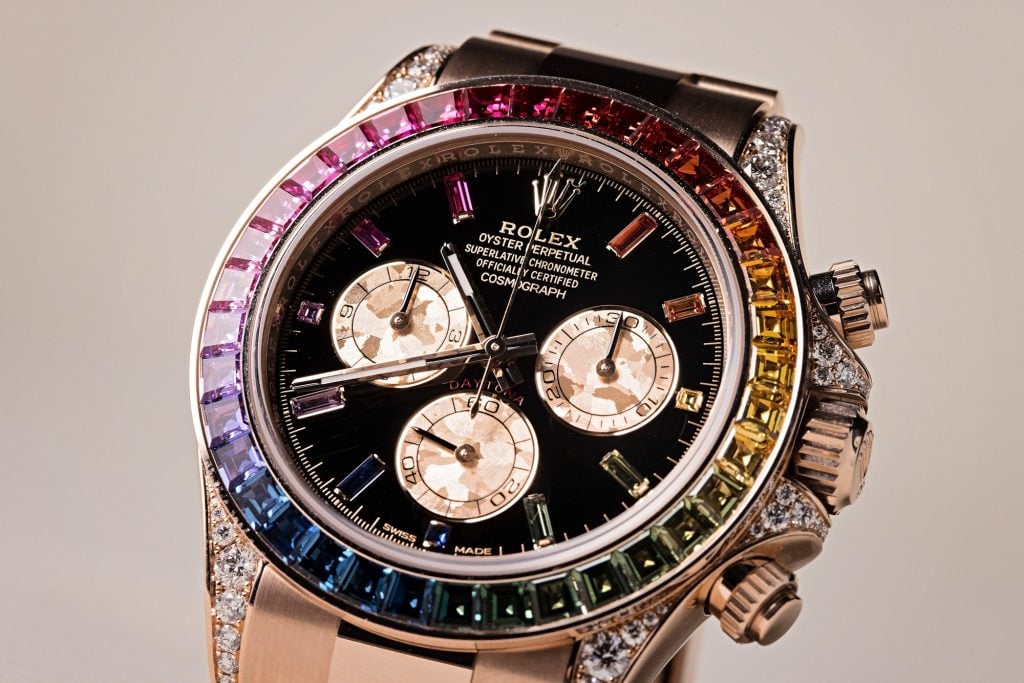
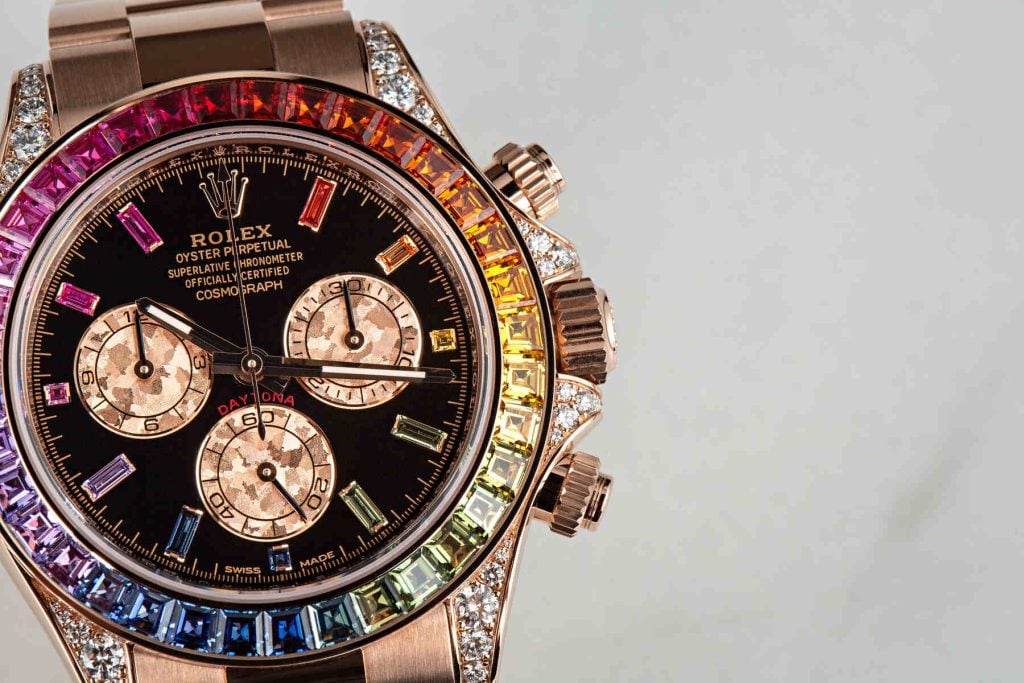
Rainbow Daytona returned in 2018 with the ref. 116595RBOW, only this time it was made from the brand’s proprietary Everose gold, an 18k rose gold alloy made in-house using a small amount of platinum. The result is a precious metal finish that doesn’t dull or fade over time as easily as other pink gold metals. This time, instead of diamond hour markers, the new Everose model displayed the time with eleven baguette cut sapphires that precisely match the colors of the stones on the bezel.
Taking the time to color-match the hour markers with the bezel creates an immaculate aesthetic throughout the watch. Rolex also made variations of the Everose Rainbow Daytona with a diamond pave dial, featuring diamonds across the dial and even on the center links of the bracelet. It quickly became one of the most sought after Rainbow Daytonas and commanded the highest prices on the used Rolex market.
A Masterclass in Gem Setting: Technical Specifications
The Rolex Daytona Rainbow is more than just a stunning statement piece. It’s a testament to Rolex’s incredible watchmaking and gem setting prowess. The Crown uses only the highest quality gems and takes care to expertly set each stone.
| Specification | Details |
| Reference Numbers | 116598RBOW, 116599RBOW, 116595RBOW, 126595RBOW, 126598RBOW, 126599RBOW |
| Case Diameter | 40mm |
| Materials | 18k Yellow Gold, 18k White Gold, or 18k Everose Gold |
| Bezel | Fixed, 36 baguette cut rainbow graduated sapphires |
| Movement | Caliber 4130 (116 series) or Caliber 4131 (126 series) |
| Power Reserve | Approximately 72 hours |
| Water Resistance | 100 meters (330 feet) |
| Bracelet | 18k gold Oyster bracelet with Oysterlock safety clasp |
The Physics of the Rainbow Bezel

The rainbow sapphire bezel is what makes this watch so special. Not to mention, it also represents an extraordinary challenge in gem selection. Rolex sources 36 baguette cut sapphires that are not only identical in size and quality but also transition smoothly from one color to the next. The perfectly-colored gradient moves clockwise from red through orange, yellow, green, blue, and finally purple. Each stone blends seamlessly with its neighbor. Rolex’s gemologists evaluate thousands of stones before finding enough that meet the brand’s strict standards for color, clarity, and uniformity.
Industry experts estimate that sourcing stones for just one Rainbow Daytona bezel can take considerable time due to the scarcity of perfectly matched sapphires. Unlike diamonds, which are graded on a standardized scale, colored sapphires vary widely in hue and saturation. Rolex reportedly uses only internally flawless stones. Of course, those staunch standards only limit the available supply. This bottleneck in gem sourcing is one of the reasons why the Rainbow Daytona is produced in such limited numbers each year.
The Brilliant Cut Case
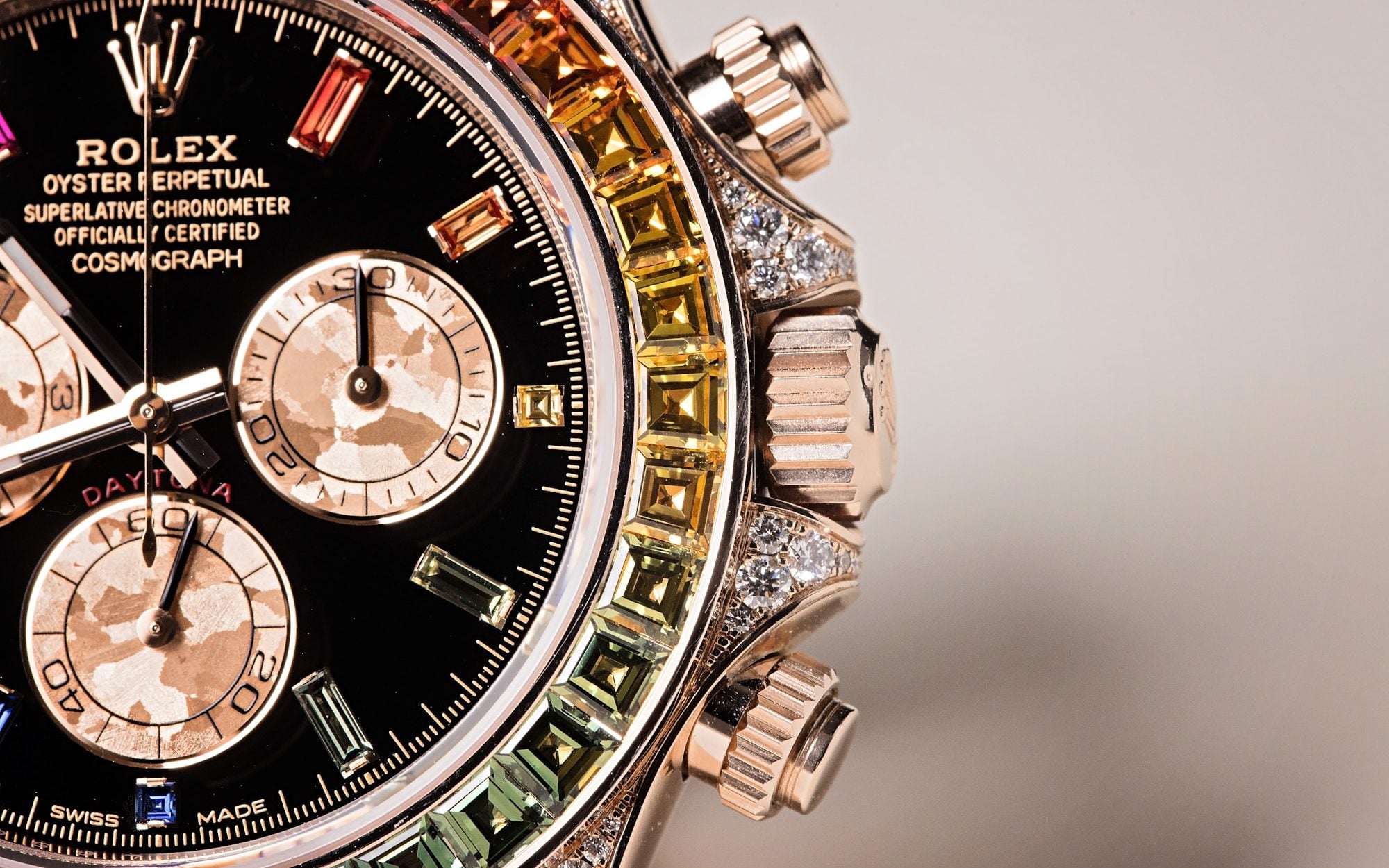
The lugs and crown guards of the Rainbow Daytona are also embellished, this time with 56 brilliant-cut diamonds. Brilliant cut is a kind of diamond cut that uses multiple facets in the stone to reflect light and maximize the stone’s overall sparkle.. The setting process involves each diamond being set at a very specific angle in order to maximize light capture from all angles. As a result, the case is dazzling from any perspective.
The diamond sizes in the lugs are determined by the available surface area and increase in size as the surface area does. Rolex master gem setters use calibrated tools to precisely cut a cavity of the correct size into the gold to seat the diamond perfectly flush with the case surface. This is important, as poorly finished gem setting can cause stones to catch on clothing or become loose over time.
Gold Crystal Sub Dials

Each Rainbow Daytona features three chronograph sub dials finished in what Rolex calls “gold crystal.” These mesmerizing sub dials use a gold alloy that has been crystallized through a process of controlled temperature changes. The metal is heated and then cooled at specific rates, causing the gold to form a distinctive textured pattern that shimmers under light. The sub dials are color matched to the case metal. Yellow gold models have yellow gold crystal registers, while Everose models have rose gold crystal registers.
This crystallization technique adds another layer of visual complexity to the dial without overwhelming the already ultra-luxurious design. The textured finish catches light differently than polished gold, creating subtle contrasts between the smooth dial surface and the shimmering sub dials. It’s one of many details that demonstrate Rolex’s commitment to craftsmanship on every visible surface of the watch.
The Heart of the Beast: Caliber 4130 vs. 4131
Don’t let all those sapphires fool you. Underneath the dazzling exterior, the Rainbow Daytona runs on the same proven chronograph movement found in every other modern Daytona. Depending on when your watch was made, you’ll find either the Caliber 4130 or the newer Caliber 4131 ticking away inside. Both are certified Superlative Chronometers, which means they exceed standard accuracy benchmarks.
Caliber 4130: The Foundation
Rolex spent five years developing the Caliber 4130 before releasing it in 2000. It has since earned a reputation as one of the best mass-produced chronograph movements ever made. The engineers stripped it down to just 201 components, about 60 percent fewer than the Zenith El Primero it replaced. Fewer parts means fewer things that can go wrong. The movement uses a vertical clutch system, so when you hit the start button, the chronograph hand moves instantly with no stutter or lag.
What really sets the 4130 apart is the Parachrom hairspring. Rolex developed this blue alloy from niobium and zirconium, and it shrugs off magnetic fields and temperature swings that would throw off a traditional hairspring. Rolex claims it boosted shock resistance by ten times, and the movement holds a 72 hour power reserve, so you can leave it on your nightstand over a long weekend without worrying.
Caliber 4131: The New Era
Rolex rolled out the Caliber 4131 in 2023. While it keeps everything that made the 4130 great, it adds a few modern touches. The big upgrade is the Chronergy escapement, which squeezes more efficiency out of every bit of energy. Rolex also dressed up the bridges with their own take on Cotes de Geneve finishing, adding a tiny polished groove between each stripe that catches the light nicely.
The 2024 Rainbow Daytona models now run on this updated movement. It’s not a revolution, but it shows Rolex is still refining what was already considered a top-tier chronograph. For buyers of the newest 126 series references, it’s a nice bonus on top of an already impressive package.
Reference Guide: Comparing the Rainbow Variants

In this next part, we’ll go over each of the three gold models. Understanding each will help you decide which Rainbow Daytona is best for your collection.
Reference 116598RBOW (Yellow Gold)
The yellow gold Rainbow Daytona was one of the two original models introduced in 2012. Its warm gold tone creates a bold, high contrast against the colorful sapphire bezel. This reference features eight brilliant cut diamond hour markers with applied Arabic numerals at the 15, 30, and 45 minute positions. Variations with rainbow baguette hour markers came to market later on. The sub dials are finished in yellow gold crystal, and the entire case and bracelet are crafted from 18k yellow gold.
It’s fairly common for Rolex to use yellow gold for its most notable luxury watches. The Rainbow Daytona in this configuration makes a particularly strong impression. The combination of the bright gold case with the rainbow sapphires creates what many consider the most visually striking version of the three. This model was discontinued in 2016 but returned in the 126 series with the updated Caliber 4131 movement.
Reference 116599RBOW (White Gold)
The white gold Rainbow Daytona is a cooler, more understated take on the gem set design. The silvery white gold case allows the colorful sapphires to stand out even more prominently since there is less competition from the case metal. Like the yellow gold version, this reference uses diamond hour markers and was part of the original 2012 release, although Rolex would also add models with rainbow baguette hour markers to the lineup. It usually appeals to collectors who want the rainbow effect without the warmth of yellow or rose gold.
One notable white gold Rainbow Daytona belongs to former soccer star Samuel Eto’o. According to various watch publications, his watch is believed to be a special commission featuring a full diamond pave dial with blue enamel Arabic numerals instead of the standard gem markers. This one of a kind configuration makes it arguably the rarest confirmed Rainbow Daytona in existence and demonstrates the lengths to which Rolex will go for its most valued clients.
Reference 116595RBOW and 126595RBOW (Everose Gold)

The Everose gold Rainbow Daytona quickly became the most coveted version after it came to market in 2018. Rolex’s Everose gold is a proprietary alloy that includes platinum to prevent the rose gold from fading over time. The warm pink tone complements the rainbow sapphires beautifully and has proven particularly popular among both male and female collectors.
In 2024, Rolex updated this model to the 126595RBOW, incorporating the new Caliber 4131 movement and subtle case refinements consistent with the broader Daytona refresh. The Everose Rainbow Daytona commands the highest prices on the secondary market, with full pave diamond versions reaching particularly stratospheric levels.
Market Value and Investment

The Rolex Daytona Rainbow has proven to be one of the most valuable modern watches on the secondary market. Original retail prices ranged from approximately $90,000 for the yellow and white gold versions to around $96,900 for the Everose model when it launched in 2018. The 2024 models carry an MSRP of just under $200,000 according to industry sources. However, these figures bear little resemblance to what buyers actually pay on the open market.
As of early 2026, secondary market listings show that standard black dial Everose Rainbow Daytonas are regularly priced between $450,000 and $650,000 for full set examples. White gold versions from the original run can be found around $320,000 to $450,000, while yellow gold models typically fall in a similar range. The diamond pave dial variants command significantly higher premiums, with some listings approaching $800,000 or more depending on condition and completeness.
The auction market has produced some remarkable results for rare Rainbow configurations. In November 2024, Phillips sold the original 1994 prototype Rainbow Daytona, Ref. 16599SAAEC, for $6.3 million at its Geneva sale. This unique piece, powered by a Zenith based caliber, predates the modern production models by nearly two decades and represents the true origin of the Rainbow concept. Its record breaking price, which Phillips confirmed set a new auction record for an automatic Daytona, demonstrates the extraordinary demand for historically significant Rolex pieces.
Authenticity: Factory Set vs. Aftermarket
When shopping for a Rainbow Daytona, the distinction between factory set gems and aftermarket modifications is particularly important to keep in mind. Factory watches come directly from Rolex with all gems installed at their facilities in Switzerland, while aftermarket versions are standard Daytonas that have been modified by third party jewelers. The difference in value between these two categories is substantial, and confusing one for the other can be an expensive mistake.
Factory Rainbow Daytonas can be identified by their reference numbers, which include the RBOW suffix. They also feature specific engravings on the case back and come with documentation confirming the factory gem setting. The stones used by Rolex meet exacting quality standards, and the setting work itself is executed with precision that aftermarket jewelers simply cannot match. An authentic factory Rainbow Daytona will maintain or increase its value over time, while aftermarket gem set watches typically lose up to 50 percent of the base watch’s value according to industry estimates.
| Factor | Factory Set | Aftermarket |
| Stone Quality | Internally flawless, perfectly matched | Variable quality, less precise matching |
| Resale Value | Strong appreciation potential | Loses up to 50% of base value |
| Documentation | RBOW reference on papers and case | Standard reference, third party cert |
| Rolex Service | Full service support | May be refused by Rolex service |
The Ultimate Statement Piece: Celebrity Owners
The Rolex Daytona Rainbow has attracted a diverse roster of celebrity owners who share one common trait: they are not afraid to make a bold statement. These high profile wearers have helped propel the Rainbow Daytona from a niche collector’s piece to a recognized symbol of success and individual style.
Musician and renowned watch collector John Mayer has been photographed wearing a white gold Rainbow Daytona on multiple occasions. Mayer’s influence on the watch market is well documented, and his embrace of the Rainbow Daytona helped legitimize it among serious collectors who might have initially dismissed the gem set design. Fellow musicians Post Malone and Adam Levine have also been spotted with Everose gold versions, while rapper Pusha T made headlines when he wore his Rainbow Daytona to the 2025 Met Gala according to watch spotting reports from the event.
The sports world has produced its share of Rainbow Daytona enthusiasts as well. Kansas City Chiefs quarterback Patrick Mahomes and Los Angeles Lakers player Anthony Davis have both been seen wearing the Everose gold model. French soccer star Antoine Griezmann celebrated his move to Barcelona by purchasing a Rainbow Daytona, while fellow footballer Zlatan Ibrahimovic has also been photographed with the rose gold version. Actor and comedian Kevin Hart owns one, as does Mark Wahlberg, who was spotted wearing his at the London premiere of Daddy’s Home 2. Even Miley Cyrus has been seen with a yellow gold Rainbow Daytona, demonstrating the watch’s appeal across genders and industries.
The Rolex Daytona Rainbow Legacy
The Rolex Daytona Rainbow has grown beyond its status as a luxury watch to become a cultural phenomenon. While other brands like Audemars Piguet and Hublot have released their own rainbow themed timepieces, none have achieved the same level of recognition or desirability as the original from Rolex. Rolex’s reputation for quality, coupled with the extreme difficulty of sourcing perfectly matched sapphires and the watch’s limited production creates a perfect storm of collectibility.
As Rolex continues to refine its gem set offerings with new references and movements, the original trio of Rainbow Daytonas remains the gold standard for collectors who demand both mechanical excellence and unrestrained luxury. Whether you are drawn to the warm glow of yellow gold, the cool elegance of white gold, or the rosy warmth of Everose, the Rainbow Daytona offers something truly unique in the world of haute horlogerie. For those with the means and confidence to wear one, few watches make quite the same impression.
At Bob’s Watches, we have witnessed the evolution of the Rolex Daytona from a professional driver’s tool into the world’s most sought after luxury chronograph. If you’re tracking down a vintage Paul Newman or hunting for the vibrant Everose Rainbow, understanding the craftsmanship behind these watches is essential to appreciating why they continue to dominate the collector market.