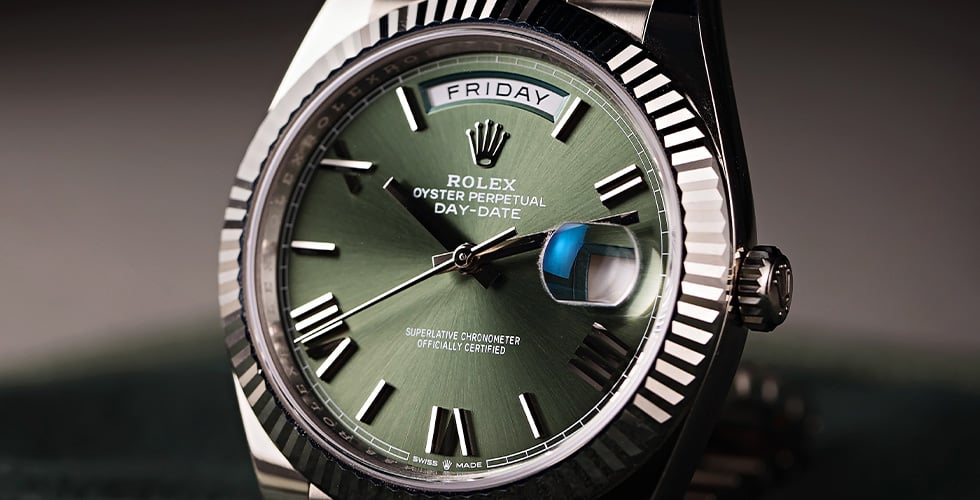
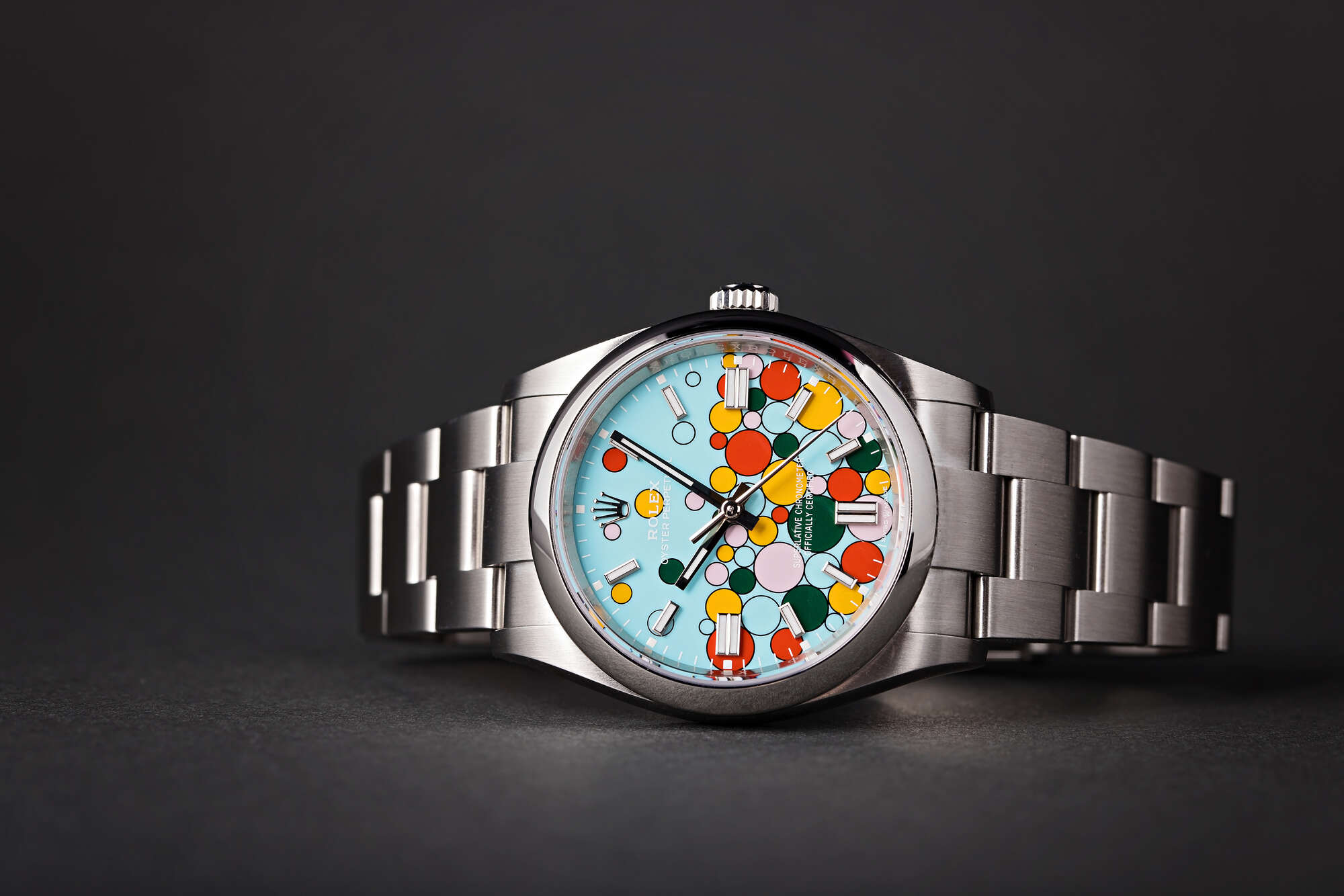
The OMEGA Aqua Terra is the definitive “GADA” (Go Anywhere, Do Anything) watch. A versatile chameleon that balances the rugged 150m water resistance of a diver with the refined elegance of a really classy dress watch. While many understandably default to the Rolex Datejust when shopping in this segment, the Aqua Terra has some serious technical prowess, including 15,000 gauss magnetic resistance and a sapphire exhibition caseback. That unmatched performance and transparency are what make it such a strong value in Swiss watchmaking today.
Key Takeaways:
- Technical Edge: Master Chronometer movements that outperform competitors in magnetic resistance and transparency.
- The “Surf and Turf” Philosophy: Designed to transition from formal boardrooms to weekend coastal adventures without changing your watch.
- Generational Gems: From the ultra-thin 11.2mm first-generation models to the cinematic “Skyfall” editions, every era has something worth collecting.
- Market Value: Pre-owned prices are tethered to intrinsic watchmaking value rather than speculative hype.
This review takes a closer look at the Aqua Terra, its history, complications, and how it’s actually performed on the market.
The “Surf and Turf” Enigma: Origins and Philosophy
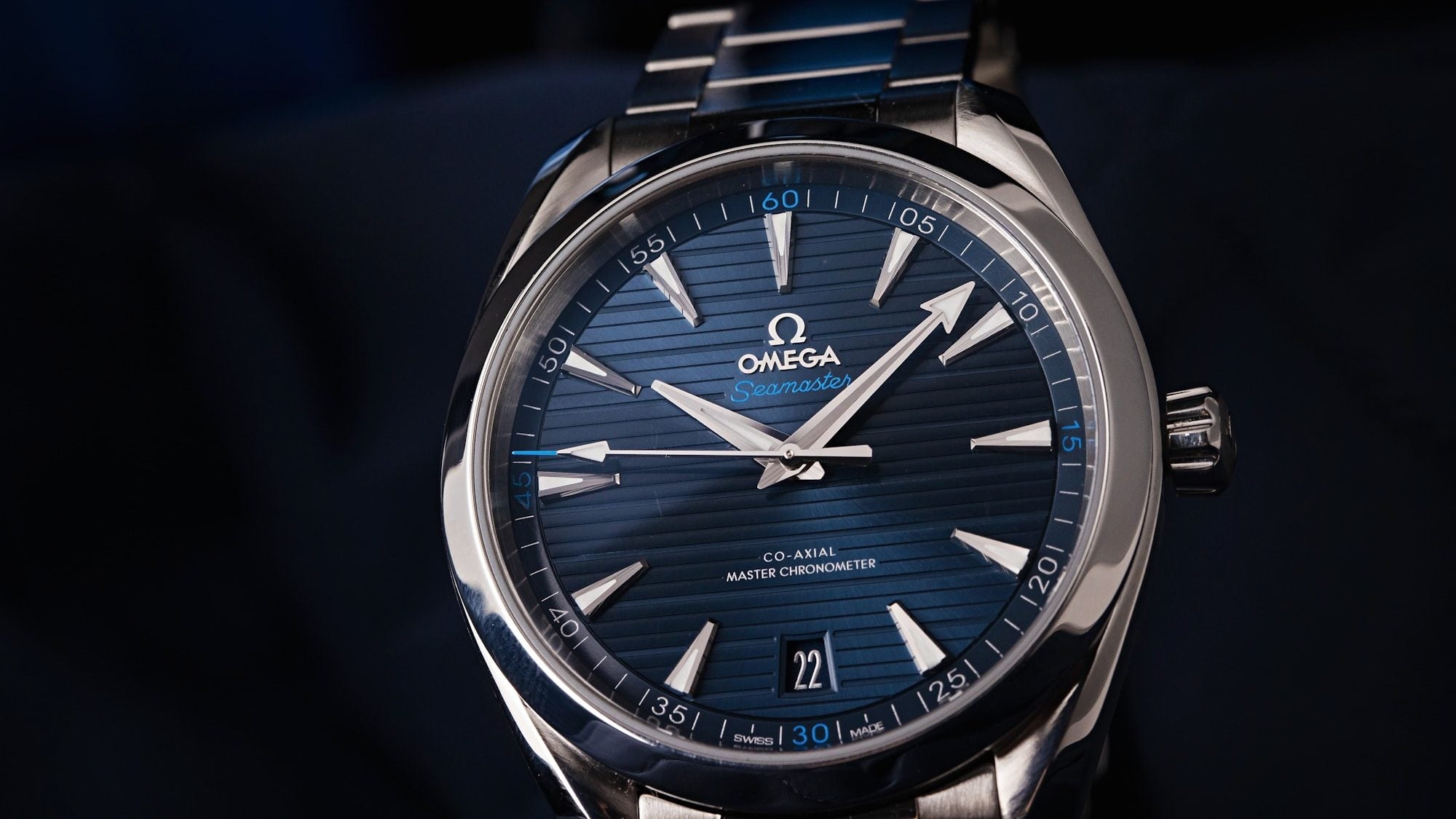
OMEGA added the Aqua Terra to the Seamaster family in 2002. The name itself told buyers exactly what it was for: “Aqua” for water, “Terra” for land. Think of it as the surf and turf of luxury watches. It was elegant enough for a suit but rugged enough for the sea, designed to be the one watch you could wear everywhere without compromise. Where the Seamaster Diver 300M was developed for professionals who needed a rotating bezel and a helium escape valve, the Aqua Terra stripped away those diving tools in favor of a smooth, polished case that paired just as well with a business shirt as it did with a wetsuit.
The philosophy goes back to the original 1948 Seamaster, which was itself a dressy, water-resistant watch with the same military-grade reliability OMEGA had supplied to Allied forces during World War II. The Aqua Terra picked up where that watch left off and modernized it with the Co-Axial Caliber 2500. Over the next two decades, the collection evolved in several different ways. Movements improved, dial options expanded, and more case sizes were added. Along the way, it earned a reputation as one of the smarter buys in luxury watchmaking. The idea behind it, though, stayed the same. One watch you can wear anywhere.
Technical Superiority: Outperforming the “Default” Choice

Any honest review of the Aqua Terra has to address the elephant in the room, the Rolex Datejust. Both watches occupy a similar niche as versatile, well-made everyday watches. But when you compare the two, the Aqua Terra pulls ahead in a couple of ways.
- Magnetic Resistance: The Aqua Terra’s Master Chronometer movements withstand 15,000 gauss, making the watch virtually immune to the magnets found in things like phones, laptops, and bag clasps. Most competitors don’t come close to that kind of magnetic resistance.
- Visibility: A sapphire exhibition caseback lets you see the METAS-certified movement at work, with Geneva waves finished in arabesque. The Datejust always has a solid caseback, so you never see the engine inside.
- Water Resistance: A robust 150 meters of water resistance, over-engineered for daily GADA use. That is enough for swimming, snorkeling, and any recreational water activity.
- METAS Certification: OMEGA tests the fully assembled watch, not just the movement, for accuracy within 0 to +5 seconds per day. This is a more rigorous standard than COSC testing alone.
None of this is to dismiss the Datejust, which has been in production since 1945 and carries an undeniable level of cultural cachet. On the secondary market, certain Datejusts command premiums that the Aqua Terra doesn’t even come close to. But for the collector who prioritizes what is actually on the wrist over what the gray market thinks, the Aqua Terra consistently delivers more watch for the money.
Evolution of an Icon: Tracking the Three Generations
The Aqua Terra has gone through three distinct generations since 2002, and each one brought meaningful upgrades to both the movement and the design. If you’re looking at a current model or digging through the pre-owned vintage market, it helps to know which generation you’re dealing with.
The First-Gen Bargain (2002–2008)
The first Aqua Terra models shipped with the Co-Axial Caliber 2500, an ETA-based movement that was accurate and thin. And “thin” is the key word here. At just 11.2mm thick, these early models are notably sleeker than their modern successors, which measure 13mm or more. If you prefer a dressier, more understated fit on the wrist, the first generation is probably one of the best options out there. The dials didn’t have the teak pattern that came later, giving them a cleaner, more traditional look. The case architecture also shared DNA with the 2003 Railmaster, another cult favorite among OMEGA enthusiasts.
Available in stainless steel or 18K yellow gold, the first generation used reference numbers in the 2502.XX (42.2mm), 2503.XX (39.2mm), and 2504.XX (36.2mm) families. There were also quartz versions available. On today’s pre-owned market, these tend to trade well below current retail and are an easy way into the collection, especially if you prefer the thinner case and slightly more old-school aesthetic.
The “Skyfall” Era and Vertical Teak (2008–2017)
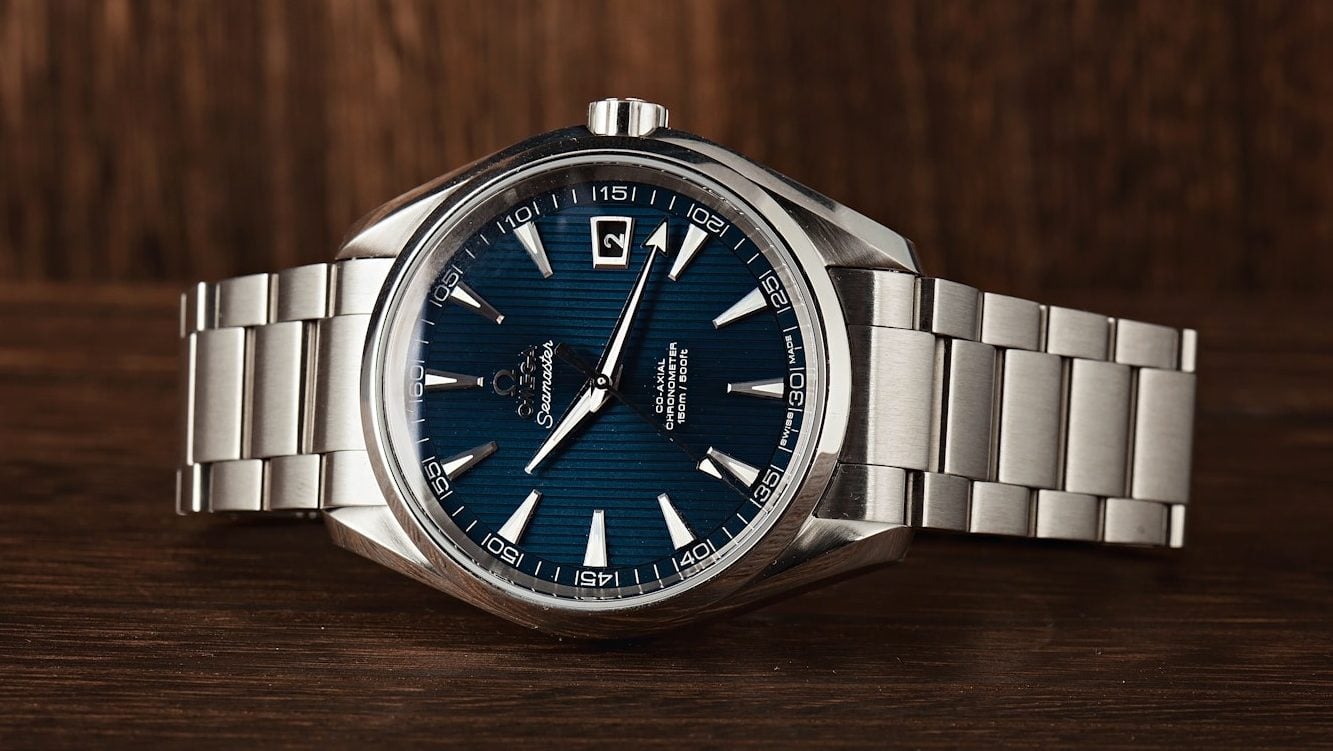
The second generation came to market in 2008 with a redesigned case, a new in-house movement, and the design element that would come to define the Aqua Terra: vertical teak stripes on the dial, inspired by the wooden decks of luxury sailboats. The hour markers were made bolder and filled with lume for improved readability, a frame was added around the date window, and the bracelet was reworked with a three-link layout and butterfly clasp. Sizes shifted to 38.5mm and 41.5mm (ref 231.XX series). Collectors consider the 38.5mm to be the “perfect proportion” for this design.
Inside, OMEGA upgraded to the COSC-certified Caliber 8500, a fully in-house movement with twin mainspring barrels, a 60-hour power reserve, and a quick-adjust jumping hour hand. This generation also saw Daniel Craig’s Bond wear a blue-dial Aqua Terra in 2012’s Skyfall, bringing the collection to a global audience. In 2013, the >15,000 Gauss antimagnetic model used non-ferrous materials inside the movement itself, paving the way for the METAS Master Chronometer standard OMEGA introduced in 2015. And in true OMEGA fashion, the 2015 Aqua Terra “Spectre” Limited Edition (ref. 231.10.42.21.03.004) combined the 15,000 gauss resistance with Bond’s 007 designation, limiting production to exactly 15,007 pieces. The blue dial features the Bond family crest, and the rotor is styled after the iconic gun-barrel opening. That model is still one of the most hunted limited editions on the pre-owned market.
Modern Classics and the Shades Collection

The current generation, launched in 2017, brought the most visible aesthetic changes yet. OMEGA flipped the teak pattern from vertical to horizontal, moved the date window down to 6 o’clock for better symmetry, and introduced a redesigned case with a conical crown and no crown guards. The metal bracelet was reworked to integrate more seamlessly with the case, and for the first time, a factory rubber strap option joined the lineup. Sizes settled at 38mm and 41mm for the standard models (ref 220.XX series), with the 43mm Worldtimer at the top.
On the mechanical side, the 38mm models use the Caliber 8800 with a 55-hour power reserve, while the 41mm models get the Caliber 8900 (or 8901 in precious metals) with a 60-hour reserve and an independently adjustable hour hand for quick time zone changes. Then in 2022 and 2023, OMEGA introduced the Shades collection in 38mm and 34mm sizes, swapping the teak grooves for sun-brushed, lacquered dials in colors like Atlantic Blue, Bay Green, Sandstone, Saffron, and Terracotta. Each dial starts as a brass blank, gets sun-brushed in a radial pattern, and receives a layer of lacquer for depth. The Shades models feel more refined, with polished cases and a redesigned bracelet. Step up to Sedna or Moonshine gold, and you’re in a different category altogether.
Sizing and Specification Comparison

One of the Aqua Terra’s greatest strengths is how many sizing options OMEGA provides. The differences between sizes go beyond diameter; each one comes with different movement options, case thicknesses, and design characteristics. Here is how the most popular configurations compare.
The Core Modern Collection.
| Feature | 38mm (Mid-Size) | 41mm (Large) |
| Movement | Caliber 8800 | Caliber 8900 |
| Case Height | ~13.2mm | ~13.5mm |
| Power Reserve | 55 Hours | 60 Hours |
| Key Function | Quick-Set Date | Jumping Hour Hand |
Vintage and Specialty Sizing
| Feature | 1st Gen (36/39/42mm) | Ladies (28–34mm) |
| Movement | Caliber 2500 | Quartz / Caliber 8800 |
| Case Height | ~11.2mm (Thin) | ~11–12mm |
| Dial Style | Gloss Sunburst | MOP / Teak / Shades |
The 38mm is often praised in online communities for hitting what many call the “golden ratio” on average-sized wrists. It wears balanced, not too large and not too small, and the Caliber 8800 is a fully certified Master Chronometer that delivers everything most people need. The 41mm has more wrist presence and adds the Caliber 8900’s independent hour hand adjustment, which is especially practical for frequent travelers. And for buyers who prefer a thinner profile and a vintage feel, the first-generation models at 11.2mm are still a compelling alternative.
A Staggering Depth of Complications
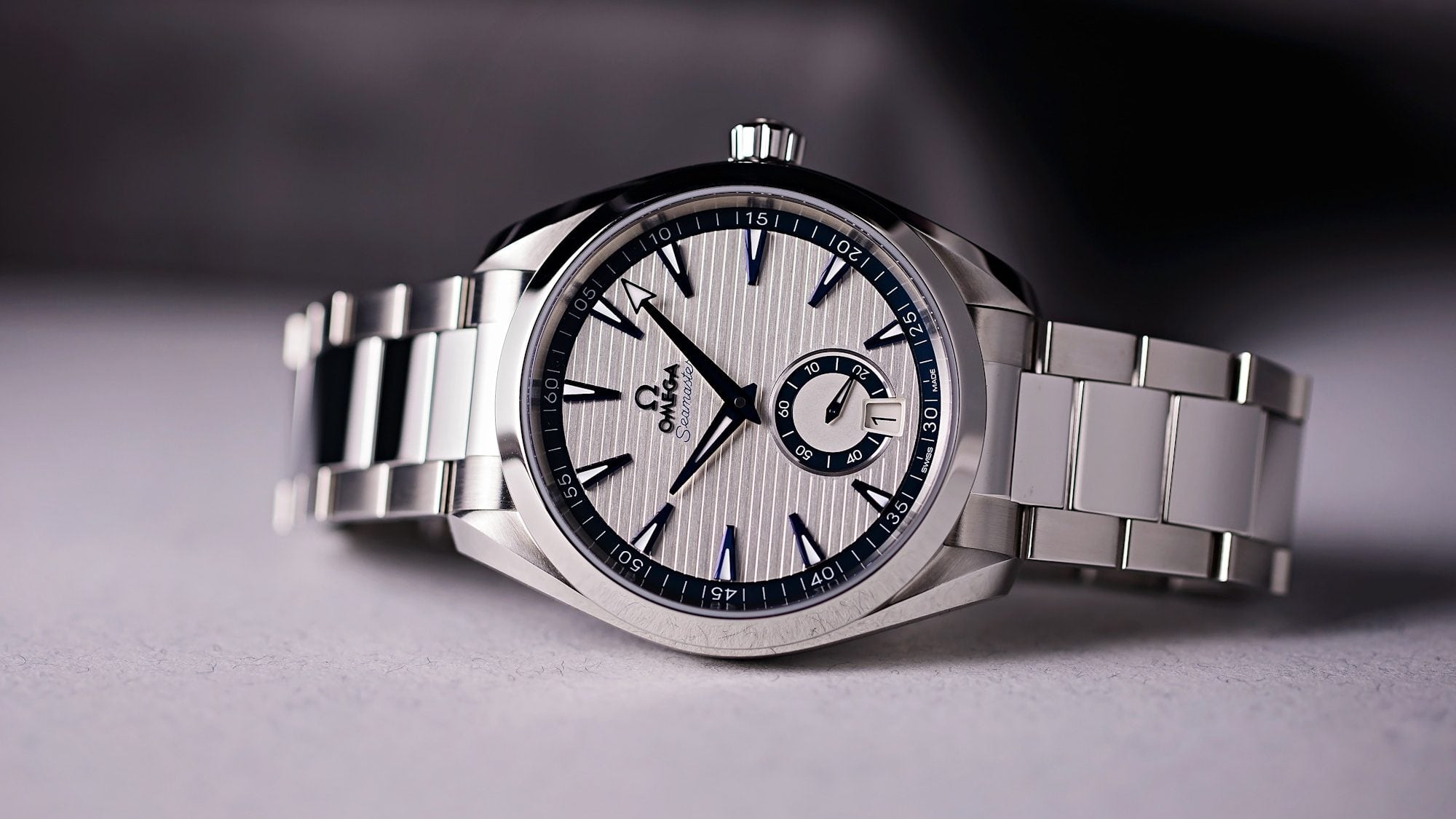
While the simple time-and-date Aqua Terra Chronometer is the heart of the collection, OMEGA has built out an impressive range of complications within the same versatile case. These are not niche curiosities; they are fully engineered, Master Chronometer certified tools that expand what the Aqua Terra can do without sacrificing its everyday wearability.
The Worldtimer is the most visually striking of the group. The watch was first released in 2017 as a limited platinum edition of just 87 pieces, with regular production steel and Sedna gold models following not far behind in 2019. The 43mm case holds a two-level dial: an outer city ring representing 24 time zones and a central sapphire disk featuring a hand-finished, laser-ablated enamel world map surrounded by a day-and-night indicator. The watch is powered by the Master Chronometer Caliber 8938. Steel versions now retail between $10,900 and $11,200 for the entry-level models. The annual calendar and GMT models brought higher-level horology into the Aqua Terra’s accessible case shape, though some of these are now discontinued and available only through the pre-owned market.
At the extreme end of the collection sits the Aqua Terra Ultra Light, a watch born from OMEGA’s partnership with professional golfer Rory McIlroy. Most golfers remove their watches before playing because the weight can affect a swing and the impact of a club striking the ball can rattle a movement. The Ultra Light solved both problems. Made almost entirely from gamma titanium, including the manually wound Master Chronometer Caliber 8928, the watch weighs next to nothing on the wrist. A telescopic crown pushes flush into the case to stay clear during a swing. At a retail price exceeding $50,000, it represents OMEGA’s most extreme engineering within this collection, the kind of technical outlier that shows just how far the brand is willing to push the Aqua Terra platform.
Market Reality: Is the Aqua Terra a Good Investment?

The luxury watch market over the past decade has been defined by speculative pricing, particularly among Rolex references that climbed far beyond their retail values during the pandemic-era buying frenzy. During that same period, the Aqua Terra behaved differently. Its pre-owned prices stayed anchored to the actual watchmaking inside the case rather than chasing hype cycles. That stability is a feature, not a flaw.
On the secondary market, pre-owned Aqua Terra watches from earlier generations can be found at meaningful discounts compared to current retail. First-generation steel models in the 2503.XX family start around $2,500 to $3,500. Second-generation Bond-era pieces in the 231.XX family typically range from $3,000 to $5,000. Even current-generation models often trade at 20 to 30 percent below their retail price. For the buyer who wants to maximize the amount of watchmaking per dollar spent, few collections in the luxury segment can compete. This is a watch to keep for a lifetime, not to flip for a “hype premium.”
The GADA Lifestyle: Versatility in Practice

The real test of a GADA watch is not in the spec sheet; it is in how the watch adapts to your actual life. The Aqua Terra passes that test better than almost anything in its price class. The current bracelet features polished center links that give the watch a premium, dressy appearance on the wrist, but OMEGA also makes it on an integrated rubber strap that completely transforms the watch’s personality. On the bracelet, the Aqua Terra belongs in a boardroom. On the rubber, it feels ready for a weekend on the coast. That ability to shift character with a simple strap change is what sets a true GADA watch apart from a watch that merely tolerates different settings.
The 150m water resistance holds up for swimming and snorkeling. The screw-down crown seals tightly, and the sapphire crystal is scratch-resistant. The anti-magnetic protection means you do not have to think twice about tossing it on a nightstand next to a phone or resting your wrist on a laptop. The Aqua Terra does not demand that you adapt to its lifestyle. It adapts to yours, from the safe to the surf, without asking you to compromise on capability or appearance.
The Enthusiast’s Sanctuary: Why the Seamaster Aqua Terra Wins

When you buy an Aqua Terra, you pay for pure, unadulterated watchmaking. That is not a knock against either watch; they serve different purposes for different buyers. What sets the Aqua Terra apart is how straightforward it is. The sapphire caseback isn’t there for show. You can actually see the movement, and OMEGA clearly doesn’t mind putting it out in the open. Same goes for METAS. It’s not just a label. The entire watch is tested to a higher standard than most brands even attempt.
At Bob’s Watches, we carry a wide mix of Aqua Terra models, from older 38.5mm models with the original vertical teak dial to newer Shades releases like Terracotta. However you come at it, the Aqua Terra continues to offer a lot for the money compared to most luxury watches.