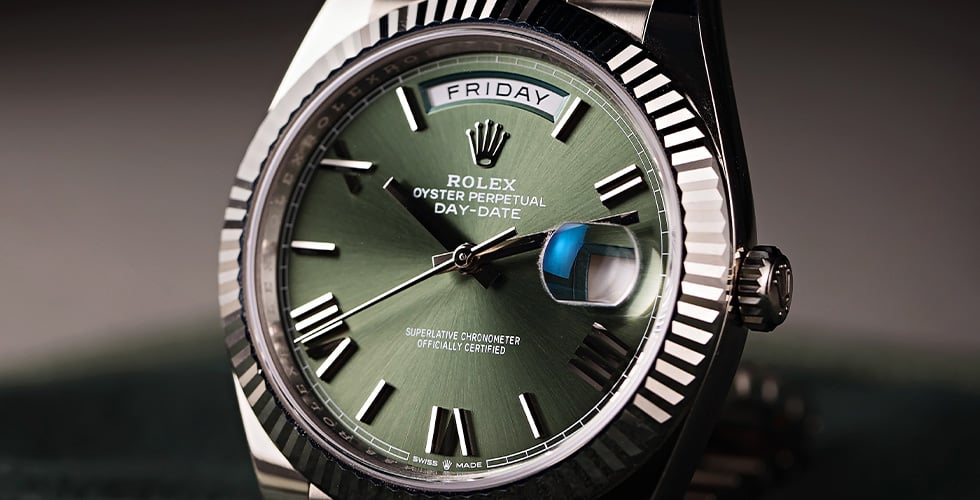
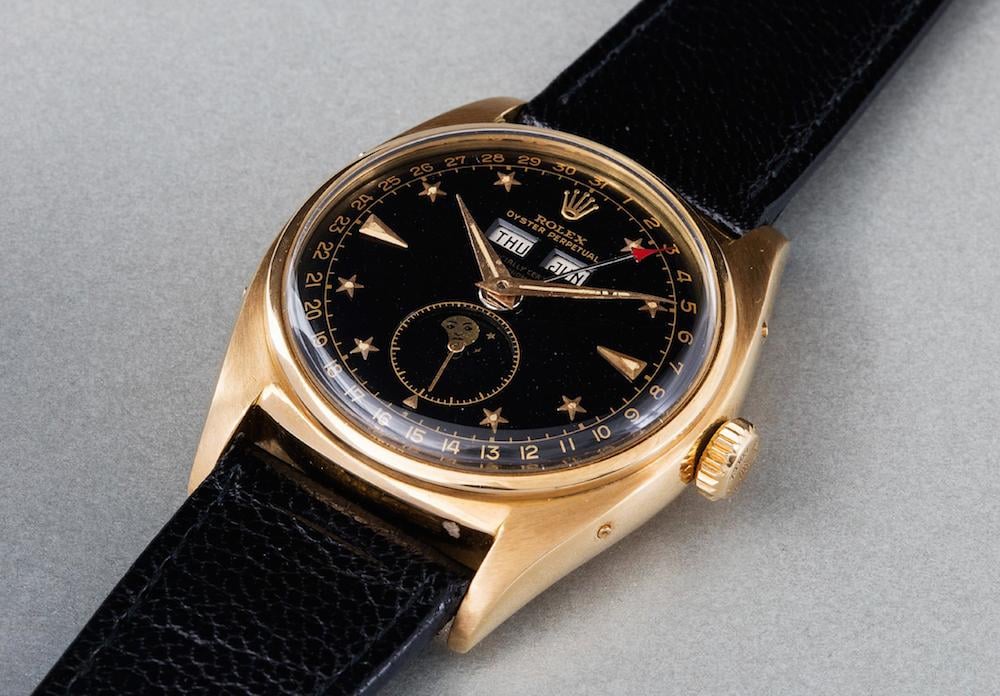
The Rolex Day-Date sits at the top of the Rolex lineup. Priced anywhere from around $8,000 for a vintage 36mm reference to well over $100,000 for a modern platinum model set with diamonds, it is the watch Rolex has always reserved for its finest materials and movements. Understanding what drives those numbers is the first step to making a smart purchase.
The Day-Date is available only in 18k gold (yellow, white, or Everose) and 950 platinum. That precious metal commitment is what separates it from every other watch in the Rolex catalog and gives it a price floor that most luxury goods simply cannot match. Beyond the metal, factors like dial rarity, bracelet condition, and the presence of original box and papers all play a role in where a specific watch lands within that broad price range.
Key Takeaways
- The entry point for a Day-Date starts at approximately $8,000 to $10,000 for vintage 36mm models like the Ref. 1803.
- Modern Day-Date 40 models in 18k yellow gold typically sell between $38,000 and $48,000 on the pre-owned market.
- Unlike nearly every other Rolex, the Day-Date has never been produced in stainless steel, which gives it a built-in intrinsic value tied directly to gold and platinum prices.
- The “President” nickname refers to the semi-circular three-link bracelet, not to the watch itself.
- Dial condition, metal type, and whether the watch comes with its original box and papers are the three biggest variables in final market value.
While “price” is a single number, “value” in the Day-Date collection is shaped by a combination of metal weight, age, dial rarity, and collector demand. This guide breaks down each of those factors so you can buy or sell with a clear picture of what you are actually getting.
Rolex Day-Date Price Table: Current Market Estimates
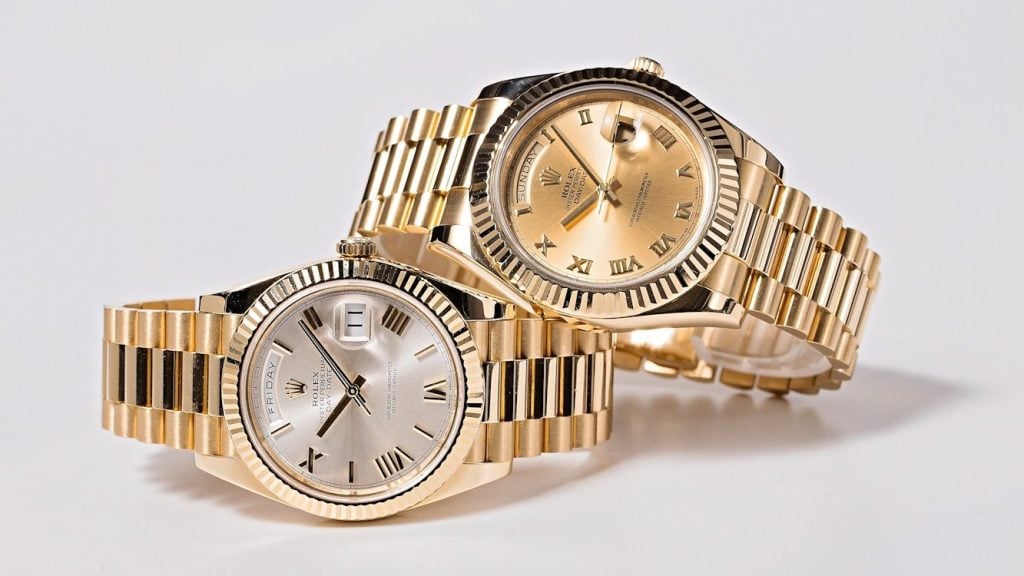
The table below shows current pre-owned market estimates across the most commonly traded Day-Date references. Prices reflect clean, honest examples with no major damage. Watches with rare dials, full original sets, or exceptional condition will often trade at the top of, or above, each range.
| Model / Reference | Specs | Est. Price (Pre-Owned) |
| Vintage (Ref. 1803) Pie-pan dial; entry point | 36mm 18k Yellow Gold | $8,500 – $12,000 |
| Five-Digit (Ref. 18238) ~114g gold; strong floor | 36mm 18k Yellow Gold | $16,000 – $22,000 |
| Six-Digit (Ref. 118238) Modern movement upgrade | 36mm 18k Yellow Gold | $22,000 – $28,000 |
| Day-Date II (Ref. 218238) Larger case; transitional ref. | 41mm 18k Yellow Gold | $35,000 – $42,000 |
| Day-Date 40 (Ref. 228238) Current standard; Cal. 3255 | 40mm 18k Yellow Gold | $38,000 – $48,000 |
| Platinum (Ref. 228236) Rarest metal; ice blue dials | 40mm 950 Platinum | $60,000 – $90,000+ |
Why Is the Rolex Day-Date So Expensive?
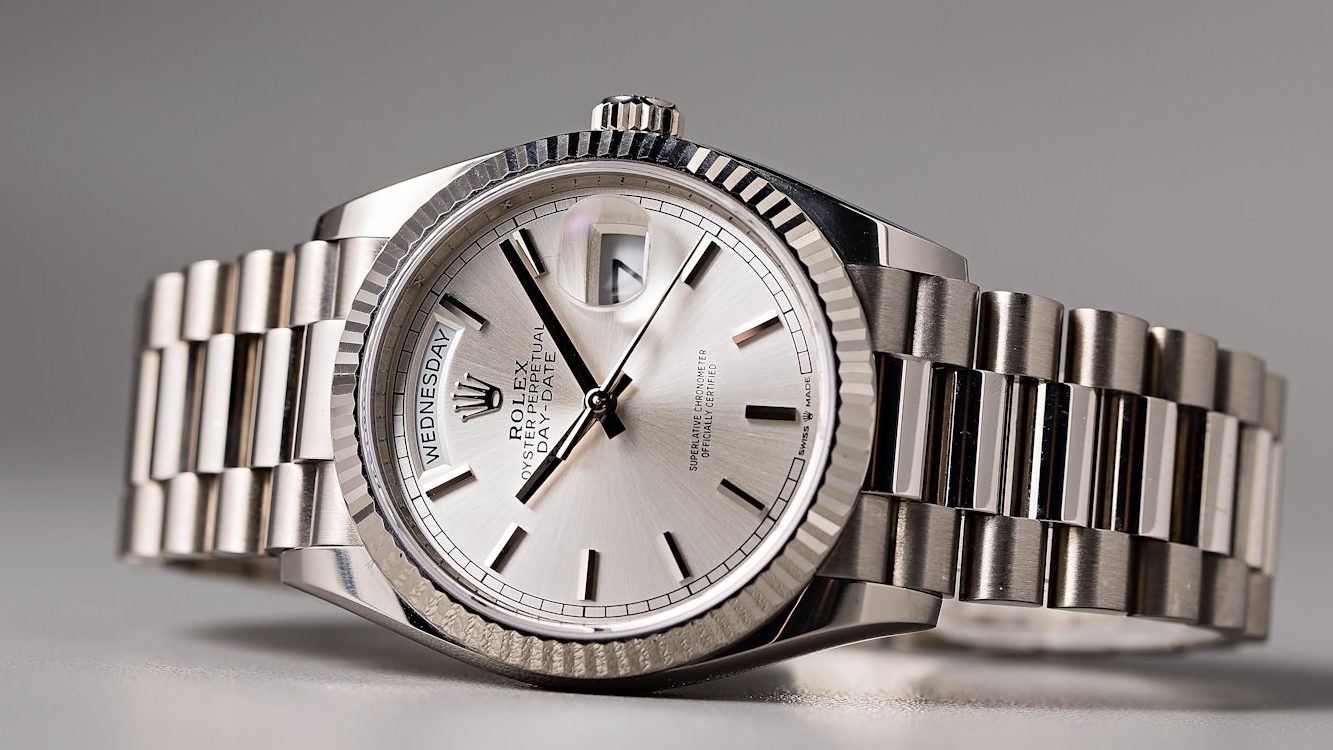
Precious Metals Only. Rolex has never produced a Day-Date in stainless steel. Every reference, from the original 1803 introduced in 1956 to the current Day-Date Ref. 228238, has been built in 18k gold or 950 platinum. That is a design decision, not a cost-cutting measure, and it means every Day-Date carries a meaningful amount of refined precious metal regardless of its age or condition. The gold alone sets a price floor below which the market will rarely go.
Intrinsic Gold Value. A fully linked Ref. 18238 contains approximately 114 grams of 18k gold across the case, bracelet, and clasp. At current gold prices, that weight alone represents a significant portion of the watch’s market value. This is sometimes called the “melt value” floor, and it is one of the reasons why Day-Dates tend to hold their value better than non-precious metal watches during broader market slowdowns.
The Movement. The current Day-Date 40 runs the Caliber 3255, one of Rolex’s most technically advanced in-house movements. It features a Chronergy escapement, 70-hour power reserve, and a level of regulation that keeps the watch accurate to within plus or minus two seconds per day. Earlier double-quickset references used the Caliber 3155, which was itself a significant engineering achievement when it was introduced. The movement quality alone justifies much of the premium over a Datejust.
Key Factors Influencing Day-Date Market Value

Even within the same reference, two Day-Dates can trade at very different prices. The variables below are the ones that move the needle most in real-world transactions, whether you are buying privately, through a dealer, or at auction.
Bracelet Condition. The President bracelet is made of solid gold links, and years of wear cause the links to stretch. A bracelet with noticeable stretch can reduce a watch’s value by thousands of dollars because gold bracelet restoration is expensive and the result rarely matches a factory-original piece. When buying, always ask about bracelet condition specifically.
Dial Rarity. A standard champagne or silver dial is attractive, but certain dial types command a serious premium. Stella dials, produced in the 1970s and early 1980s in vivid lacquered colors, regularly trade at multiples of a standard-dial equivalent. Stone dials in materials like onyx, lapis lazuli, or malachite, and meteorite dials on modern references, can also double or triple the value of a given watch. Condition matters here as well; stone dials can crack, and lacquer dials can fade.
Box and Papers. A complete set, meaning the watch arrives with its original Rolex box and warranty card (or chronometer certificate for older models), typically commands a 10 to 15 percent premium over a “watch only” sale. Papers confirm the reference number, serial number, and original point of sale, which is especially important for vintage watches where provenance can be difficult to establish.
Aftermarket Modifications. Factory-original dials and bezels are what collectors pay for. An aftermarket diamond bezel or a dial that has been set with stones outside of the Rolex factory can actually hurt resale value compared to a factory-stock example. If a watch is presented with added diamonds, always ask whether the work was done by Rolex or by a third party, and get that confirmed in writing.
Buying Vintage vs. Modern: Where Is the Best Value?
The Day-Date collection spans more than six decades, and the right choice depends on what you are looking for in a watch. Vintage references offer character and a lower entry price. Modern references offer better wearability and the reassurance of current production standards. Both have a place in the market, and both have loyal followings.
The Entry Point: Ref. 1803 and 18038

The Ref. 1803, produced from 1959 to around 1977, is still the most accessible way to own a President. These watches feature the distinctive “pie-pan” dial, a slightly concave surface with a raised outer chapter ring that gives the watch an almost architectural quality. Well-kept examples with original dials in good condition typically sell in the $8,500 to $12,000 range, which is a remarkable value for a solid gold Rolex with a working President bracelet. The 18038, which followed from 1978 onward, added the quickset date function and a more modern dial layout while keeping the same 36mm case size.
The main considerations with vintage buying are bracelet stretch, dial condition, and movement service history. A vintage Day-Date that has been worn daily for 40 years without proper bracelet care will show it. That said, a clean example from a reputable seller, with honest photos and a stated service record, represents one of the better values in the entire luxury watch market.
The Modern Standard: Ref. 228238
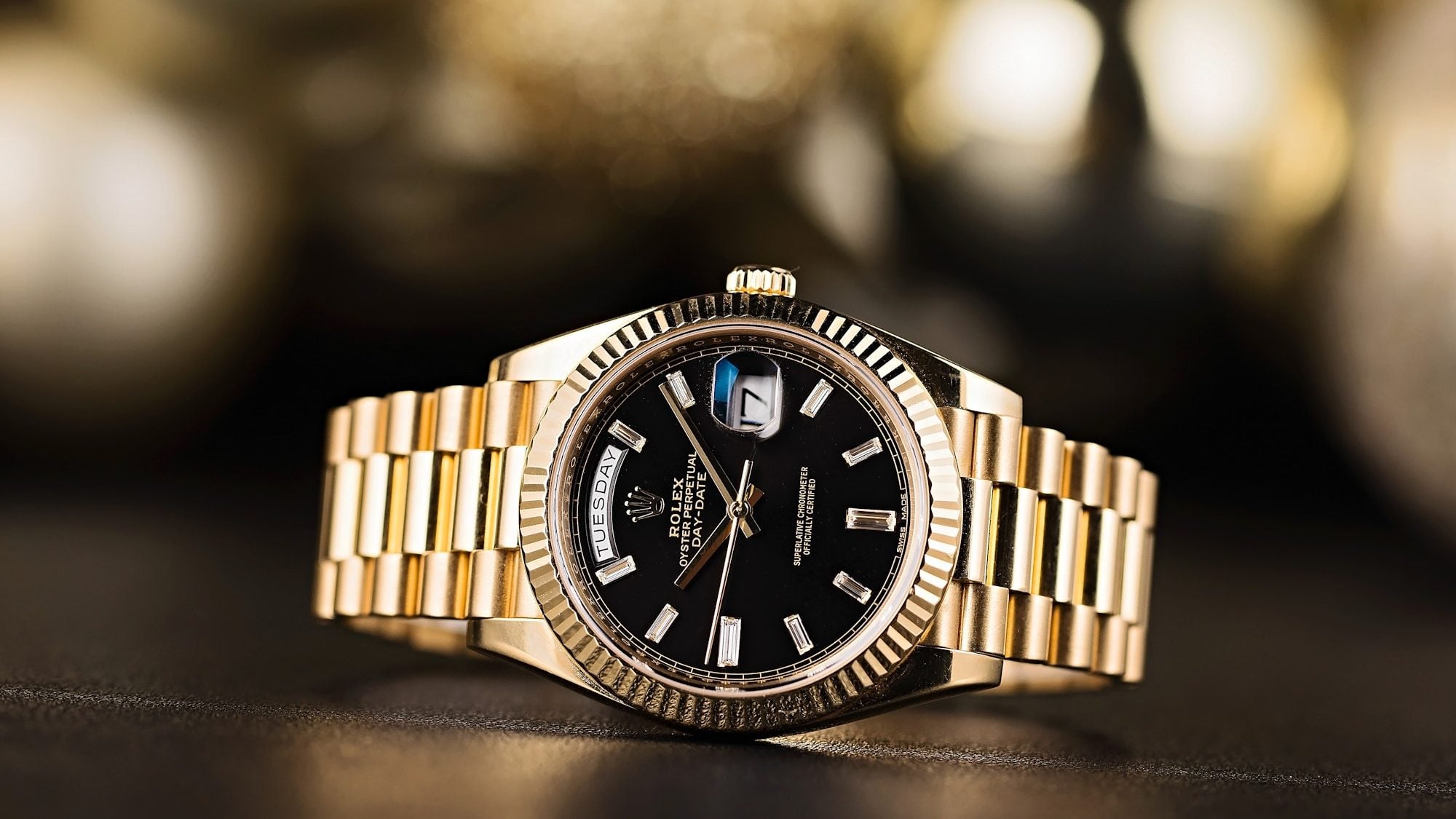
The Day-Date 40 (Ref. 228238) is the current production model and the watch most buyers are looking at when they think of a new or recent pre-owned President. The 40mm case hits a sweet spot for modern wrist sizes, and the upgraded President bracelet features ceramic inserts in the links that significantly reduce the stretching problem associated with earlier gold-only construction. The Caliber 3255 inside is one of Rolex’s best, and the range of dial options available directly from Rolex, or on the pre-owned market, is broad.
Pre-owned examples of the 228238 typically sell in the $38,000 to $48,000 range depending on dial color, condition, and whether the set is complete. Yellow gold with a champagne or brown dial tends to be the most common, while white gold with a meteorite dial or Everose gold with a chocolate dial will often trade toward the top of the range. For a buyer who plans to wear the watch regularly, the modern reference is worth the premium over vintage given its improved bracelet durability and service infrastructure.
Rolex Day-Date Price Trends and Investment Outlook

Sales data going back to 2010 tells a clear story about how this market has moved. Average Day-Date selling prices held in the $8,000 to $14,000 range from 2010 through 2019, with consistent year-over-year growth. Volume expanded significantly after 2012 as the pre-owned market matured, and by 2018 and 2019 the average transaction was closing between $13,000 and $14,000. The pandemic-era demand surge then changed the picture quickly. By 2021, average sale prices had climbed to roughly $22,800, with peak quarterly averages reaching approximately $27,000 in Q4 of that year.
The correction that followed in 2022 affected the Day-Date considerably less than it hit steel sports references. From the Q4 2021 peak, average Day-Date prices pulled back to around $21,700 by Q3 2022, a decline of roughly 20 percent over three quarters. Many comparable steel models fell 40 percent or more during the same window. By 2023 and 2024, Day-Date averages had stabilized in the $22,000 to $25,000 range. Momentum picked back up heading into late 2025, with Q4 2025 averaging over $30,000 per transaction, and early 2026 figures running around $32,600. The current production Day-Date 40 (Ref. 228238) has averaged approximately $38,900 in actual completed sales, which aligns closely with where the market sits today. For buyers and sellers alike, those numbers reflect a sports watch that moves with the broader economy but does not collapse under speculative pressure the way that steel references have.
Pro Tip: If you are buying as an investment or planning to resell, focus on factory-original examples with clean dials, minimal bracelet stretch, and complete paperwork. Those are the pieces that attract the most competitive bidding and command the strongest prices in any market condition.
Navigating the Rolex Day-Date Market

The Rolex Day-Date price may seem high at entry, but the combination of solid gold construction and decades of historical prestige makes it one of the few luxury purchases that holds its value over time. Whether you are looking at a vintage 36mm reference or a modern 40mm, you are buying into a watch that has been on the wrists of heads of state, business leaders, and watch collectors since 1956. That is not marketing language. It is a track record.
When it comes to vetting sellers, prioritize dealers who provide detailed, high-resolution photography of the dial, bracelet, clasp, and case back. Ask directly about bracelet stretch, service history, and whether any parts, including the dial or bezel, have been replaced. Aftermarket diamond additions are common in this segment and can significantly affect resale value compared to a factory-configured example. A trustworthy seller will disclose these things upfront. If you are ever uncertain, having the watch examined by an independent watchmaker or a reputable authentication service before completing the purchase is always the right call.